AI visibility scores: what they measure and what they do not
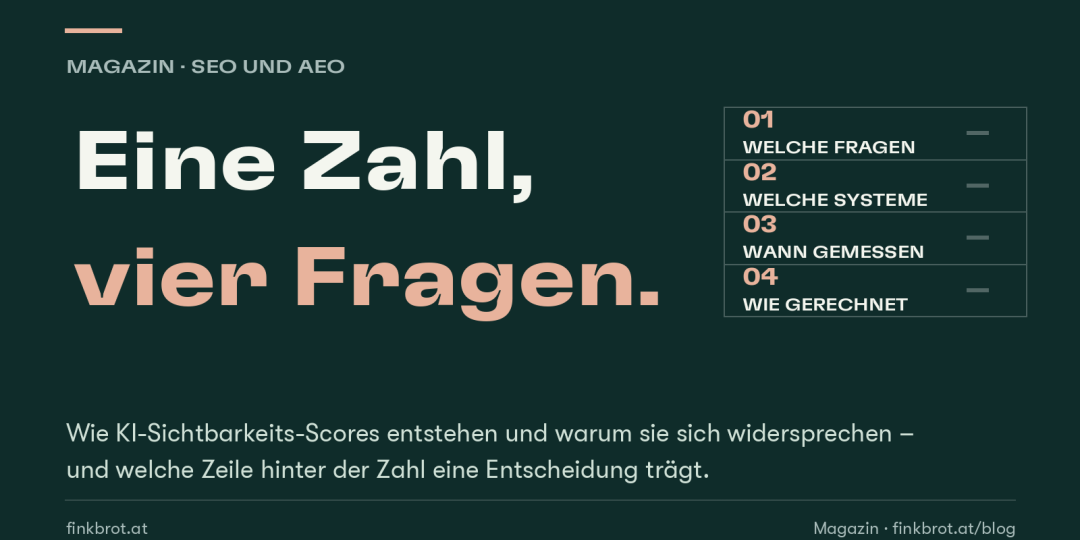
AI visibility scores are samples that a tool draws with its own questions, systems and arithmetic; two tools deliver different values for the same brand. Since 31 August 2026 Google has reported impressions in AI Overviews, but no position within them. OpenAI documents four programs it uses to fetch websites (user agents), and a score would have to check all four. What bears weight is the line behind the number: date, system, wording.
There are tools that promise a number: your visibility in ChatGPT, Google’s AI Overviews and Perplexity, as a score from 0 to 100. Anyone buying that number should know what it contains.
What an AI visibility score is
Tools such as Peec AI, Otterly.AI, Profound, Scrunch, the AI section of Semrush or Ahrefs Brand Radar put a list of questions to AI systems. They record which brands and websites appear in the answers and turn that into a number. The score is therefore not a measurement released by an AI system, but the result of a sample the tool draws itself. We name the tools here as examples without assessing their methods in detail. We can only substantiate what the AI providers themselves document, and that is what the rest of this article is about.
How the number comes about: four decisions
Four decisions go into every score, and your customers make none of them.
- The questions. Which questions are asked is decided by the tool, often with suggestions from a language model; nobody checks whether your customers ask that way.
- The systems. ChatGPT with or without search, Google’s AI Overview (the summary above the results) or AI Mode (the chat view of Google Search), Perplexity, Gemini, Claude. Each of them answers differently, and every model version differently again.
- The timing. The same question to the same system yields two answers on two days, sometimes on the same day.
- The arithmetic. Does a mention without a link count? Does the position in the answer count? How are questions weighted?
Each of the four decisions changes the number, and not every tool discloses all four.
This article in three sentences:
An AI visibility score is the result of a sample that a tool draws with its own questions, its own systems and its own arithmetic. Two tools deliver different values for the same brand because they make these decisions differently and because AI systems do not answer the same question the same way twice. What bears weight is the line behind the number: date, system, wording of the question, wording of the answer.
Why two tools deliver different values for the same brand
Because they ask different questions, at different times, of different systems, and aggregate the result differently. On top of that there is no shared yardstick a score could be measured against. For AI Overviews Google publishes no visibility score, only impressions, and OpenAI publishes nothing at all for ChatGPT. A score of 42 in one tool and 67 in another do not contradict each other; they measure different things. Anyone who wants to compare two values first needs the question list and the date behind each one.
What Google itself provides, and what it does not
Since 31 August 2026 the report on generative AI features in Google Search Console has been rolled out to all websites worldwide. Sites with very few impressions in AI features do not see it. It counts impressions, that is, how often links to a website were displayed in AI Overviews and AI Mode, by pages, countries, dates and devices. The report contains no clicks, no position and no queries; the clicks remain in the regular performance report. And a position within an AI Overview does not exist in Google’s data: the overview occupies a single position, and all links in it get the same one. A tool that reports “position 2 in the AI Overview” reports something Google itself does not measure. For inclusion in these features the same fundamentals apply as for Search, according to Google; a separate file or markup is not part of it.
What OpenAI documents, and why a score has to check it
OpenAI documents four programs it uses to fetch websites (user agents). For search in ChatGPT, OAI-SearchBot is the one that counts. The file robots.txt tells such programs whether they may access a site; a site that excludes OAI-SearchBot there is not shown in search answers. They can still appear as a plain link to the site; OpenAI calls that a navigational link. GPTBot collects training data, ChatGPT-User fetches pages when a user asks, and according to OpenAI robots.txt rules may not apply to it; OAI-AdsBot checks ad landing pages. A score that reports “not mentioned” without checking robots.txt cannot tell a block from a weakness. That difference decides the action: one line in robots.txt costs an hour, content work costs a year.
How to recognise a usable tool
By six things. The question list is visible, and you can replace it with the questions your customers ask. Every answer can be exported with date, system and wording. Systems, model versions and repetitions per question are disclosed. Crawler access is checked as well. No position within an AI Overview is claimed. And the price follows the number of questions you actually need, not the number the tool suggests. If one of the six is missing, the number is a claim.
What we do instead
We work without a score. We put a fixed list of test questions that your customers actually ask to three AI systems, repeatedly and with a date. We record four measures: how often an answer mentions you, how accurately, whether the systems’ reading programs may fetch your pages, and how many visits actually arrive. Every figure carries a date and a sample size, and you get the line behind it. How this works in detail is on the measurement method page. The free citability check goes through 17 points in a minute and shows whether your website meets the requirements.
When a score still helps
In two cases. First as a trend: if the question list stays the same, the number shows a direction over months, even if its absolute value says little. Second as a comparison within the same tool, say between you and three competitors, because then all four decisions are the same for everyone. As proof of success for management or clients, the number only works together with the lines behind it. Anyone who does not get them has bought a score, not a measurement.
Frequently asked questions about AI visibility scores
Can I see visibility in AI answers in Google Search Console?
Why does a tool report a position in the AI Overview when Search Console does not?
Is blocking GPTBot enough to stay out of ChatGPT?
Source: OpenAI: Overview of OpenAI crawlers (retrieved 8 September 2026) (opens in a new tab)
Does my website need special markup to appear in AI Overviews?
What do these tools cost?
If you want to know where your website stands in AI answers today, without a score: give us one question your customers ask. We put it to three AI systems on a recorded date and send you the result in writing, free of charge within five working days. Request the free SEO check.
Matching services
We can also support you directly on this topic — these pages are worth a look.
AEO & GEO
AEO and GEO from Vienna: we prepare your website content clearly, verifiably and machine-readably – with no promise of being cited in AI …
Read more →Measurement method
How FINK Brot measures visibility: in Google Search with raw Search Console data, in AI answers with dated test questions in three systems. …
Read more →Citability check
Free check across 17 verifiable criteria: is your website ready to be cited by ChatGPT and friends? No score, no sign-up, nothing stored …
Read more →