The withdrawal button: what online shops must offer from 1 October 2026
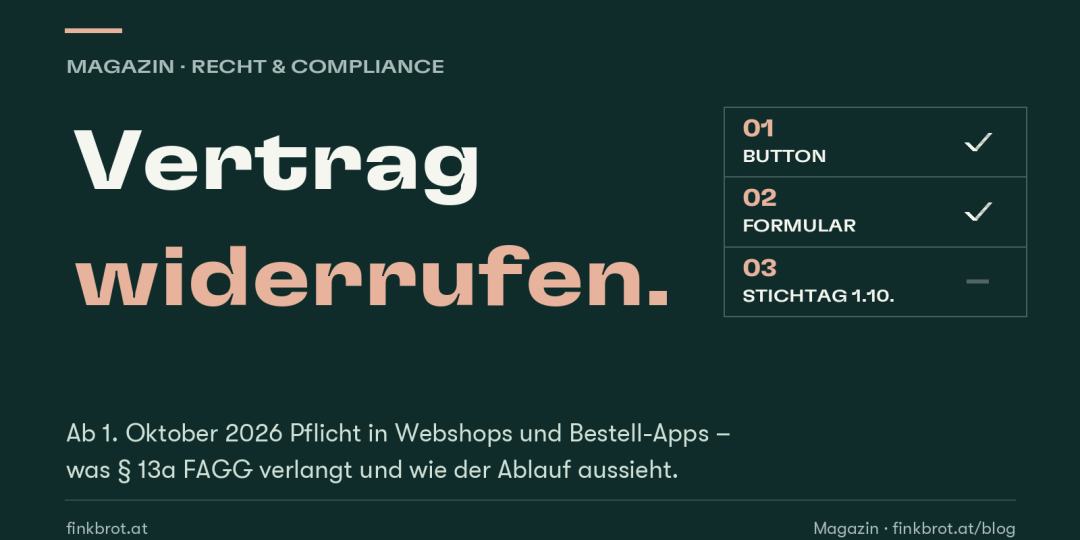
From 1 October 2026, companies concluding contracts with consumers via a website or app must offer an online withdrawal function, known as the withdrawal button. The basis is Directive (EU) 2023/2673 and the new section 13a FAGG, the Austrian distance selling act. The provision is part of the Consumer Law Amendment Act 2026, published on 28 July 2026. The button carries the words „Vertrag widerrufen“ (withdraw from contract), leads to a form with three details and ends with a „Widerruf bestätigen“ (confirm withdrawal) control. An acknowledgement of receipt with date and time must then follow without delay, for instance by email. The duty applies to contracts concluded after 30 September 2026. Without the function, a fine of up to 1,450 euros is possible. In Germany the parallel provision, section 356a BGB, already applies. This article is not legal advice.
Ordering in an online shop takes three clicks. Withdrawing from the contract often took more: finding a form, writing an email, locating an address. From 1 October 2026, withdrawing in Austria must be as easy as ordering itself – via a withdrawal button directly in the shop.
This article explains where the duty comes from, who it covers and what the function must look like. The references for every statement are listed at the end of the article and in the frequent questions. What the article does not do: assess an individual case. Whether a specific sales channel falls under the new rule is a matter for legal advice.
The withdrawal button is a legally required function that lets consumers declare their withdrawal from a contract concluded online directly on the website or in the app. The statute calls it the withdrawal function and states that the contract can “also” be withdrawn from via this function. The withdrawal button therefore does not replace the existing channels, it adds a simple one alongside them.
The duty stems from Directive (EU) 2023/2673. It inserts a new Article 11a into the Consumer Rights Directive 2011/83/EU. Member States had to adopt the rules by 19 December 2025 and have to apply them from 19 June 2026. Austria implemented later. The Consumer Law Amendment Act 2026 (Verbraucherrechts-Änderungsgesetz 2026) was published in the Federal Law Gazette on 28 July 2026. The new section 13a FAGG, part of the Austrian distance selling act, enters into force on 1 October 2026. The idea behind it appears in the directive’s recitals: withdrawing should not be more cumbersome than concluding the contract.
The withdrawal button, called the withdrawal function in the statute, is mandatory in Austria from 1 October 2026. It covers distance contracts concluded via an online interface such as a website or app. It consists of a button with the words „Vertrag widerrufen“ (withdraw from contract), a form and a confirmation control labelled „Widerruf bestätigen“ (confirm withdrawal). The shop must then send an acknowledgement of receipt without delay.
Source: RIS: VerbRÄG 2026, BGBl. I Nr. 59/2026 (opens in a new tab)
Who does the duty apply to?
The duty applies to traders concluding distance contracts with consumers via an online interface, for instance through an online shop or an ordering app. Distance contracts for financial services are covered as well, under the new section 1a FAGG. Anyone concluding contracts exclusively through individual communication by email or telephone does not fall under the new provision by the wording of section 13a FAGG.
The statute does not separately define an online interface; the directive’s recitals name a website or an application as examples. A second question also remains open. Must the function be available when, exceptionally, no right of withdrawal exists for the specific contract, for instance under the exceptions in section 18 FAGG? The statutory text does not answer that expressly. In case of doubt, such questions are for legal advice.
A look across the border is still worthwhile. Germany has implemented the same EU requirement as section 356a of the German Civil Code (BGB), and the withdrawal function already applies there. Anyone selling from Austria to customers in Germany should therefore not leave the date until autumn. Whether German law applies to a specific shop is, again, a legal question. The withdrawal button is not to be confused with the German cancellation button under section 312k BGB. The cancellation button ends ongoing contracts such as subscriptions; the withdrawal button dissolves a freshly concluded contract within the withdrawal period.
Section 13a FAGG prescribes three stages. It starts with a clearly legible button with the words „Vertrag widerrufen“ (withdraw from contract) or equally unambiguous wording. A form for three details follows, and it ends with a confirmation control labelled exclusively „Widerruf bestätigen“ (confirm withdrawal) or equally unambiguous wording. The function must be continuously available throughout the withdrawal period, prominently placed and easily accessible.
The form must allow three details: the name, details identifying the contract, such as an order number, and the channel for the acknowledgement of receipt, such as an email address. Once the confirmation control is activated, the trader must without delay send an acknowledgement of receipt on a durable medium, for example by email. It contains the content of the declaration and the date and time of its arrival.
The directive’s recitals make accessibility concrete. Nobody should have to download an app first in order to withdraw if the contract was not concluded through that app. Anyone already identified, for instance by logging in, should be able to withdraw without identifying themselves again. As a simple route to the function, the directive mentions hyperlinks. A form reachable only inside a customer account sits uneasily with these requirements.
This is what the flow can look like in a shop: the footer, the order confirmation and the help page carry a link with the words „Vertrag widerrufen“. It leads to a dedicated page with a form: name, order number, email address. Below it, a control labelled „Widerruf bestätigen“. After sending, the system automatically dispatches an email reproducing the content of the declaration and the date and time of receipt. Technically the withdrawal button is manageable: one page, three fields, one automatic email with a timestamp.
When does the withdrawal count as being on time?
The right of withdrawal counts as exercised in time if the online withdrawal declaration was submitted before the withdrawal period expired. The period is 14 days under section 11 FAGG. What matters is submitting the declaration through the function, not the moment the trader reads it.
Source: RIS: VerbRÄG 2026, BGBl. I Nr. 59/2026 (opens in a new tab)
What changes in the withdrawal information?
The withdrawal information must in future also state that the withdrawal function exists and where it is placed. The model withdrawal form under Annex I Part B remains part of the information alongside it. Both are set out in the newly worded section 4 paragraph 1 number 8 FAGG. Anyone installing the button without adapting the information has met the duty only halfway.
That half is expensive. If the trader does not comply with the information duty under section 4 paragraph 1 number 8 FAGG, the withdrawal period is extended by twelve months under section 12 FAGG. The Austrian Economic Chamber suggests wording for the information. One example, in translation: “You can also exercise your withdrawal via our withdrawal button.” It also recommends keeping the statutory wording for the labels. Deviating labels could be read as unclear.
Anyone not offering the withdrawal function, or not in the prescribed form, commits an administrative offence from 1 October 2026. Section 19 FAGG provides for a fine of up to 1,450 euros. Added to that is the extended withdrawal period from the previous section if the information is missing too. The sensible next step is an inventory: where in the shop are contracts concluded, and where should the button live?
If the withdrawal function is missing or does not meet the requirements of section 13a FAGG, that is an administrative offence from 1 October 2026. The fine is up to 1,450 euros. If the notice in the withdrawal information is missing as well, the withdrawal period is extended by twelve months.
Source: RIS: FAGG § 19, version in force from 1 Oct 2026 (opens in a new tab)
The technical implementation
The function needs no new system, but a few deliberate decisions. The button belongs, as a real labelled control, in areas reachable from every page, such as the footer. The form page works without signing in. The statute names three details. Every additional mandatory field lengthens the route and raises the question whether withdrawing is still as easy as ordering.
The system sends the acknowledgement of receipt automatically, with the content of the declaration and the date and time from the server clock. The receipt should additionally be logged internally so the moment can be evidenced later. And the function must be available throughout the whole withdrawal period. The form endpoint thus becomes part of the shop’s core from October: it belongs in every monitoring setup and in every test after an update. How strictly authorities and courts will read the requirement of prominent, easily accessible placement, we do not know; we are not aware of any Austrian decision on it yet. Building the function visibly and plainly defuses that question before it arises.
For the shops we look after, we plan the implementation as in the practical example above. That means a dedicated withdrawal page, linked from the footer and the order confirmation, plus the automatic acknowledgement. Whether a specific implementation satisfies the legal requirements is ultimately for a law firm to assess. The technical route there is built in a few days.
That leaves the question of what can realistically be done by 1 October. The answer is friendlier than for many other digital laws: the withdrawal button is a clearly defined, small function with unambiguous wording, plus two more sentences in the withdrawal information. Our glossary explains the terms behind it, such as the right of withdrawal in distance selling. And anyone unsure whether their own shop is covered: that is for legal advice to settle, gladly on the basis of a technical inventory from us.
Matching services
We can also support you directly on this topic — these pages are worth a look.
Glossary
The FINK Brot glossary explains key terms from search engine optimisation, web development, digital accessibility, structured data and AI – …
Read more →Websites
Websites on Kirby CMS: compact from €2,900, custom from €4,500 net. Fast, data-minimising, accessible from the start. For businesses across …
Read more →