AI agents, explained for holiday lets
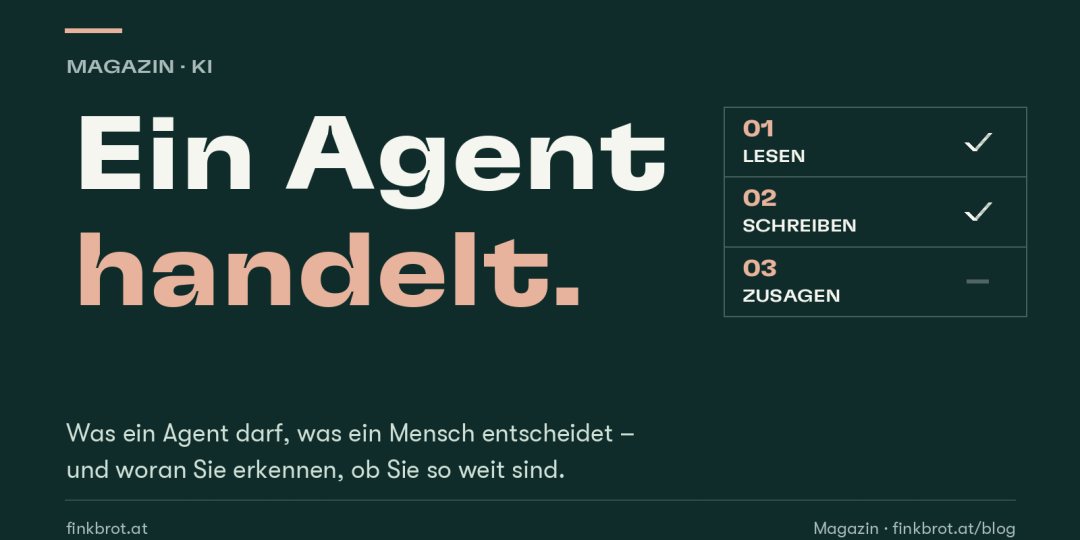
A chatbot gives information from stored texts. An agent may also do something: check the calendar, pencil in a hold, send an email. The benefit sits in that access, and so does the risk. Three kinds of error occur in practice: the invented answer, the right answer about the wrong property, the action without cover. On liability for a wrong promise we found no reliable source for Austria. It can be avoided anyway: the agent states prices, the promise stays with a human. Since 2 August 2026 such a system has to be built so the guest notices a machine is answering; that duty sits with the provider. With two flats and twenty enquiries a month, an agent is not worth it.
A chatbot answers. An agent acts. The difference sounds small, and it decides how much can go wrong when the machine gets it wrong.
This piece answers four questions worth settling before you introduce one. What an agent is. Whether it can handle guest enquiries. Who is on the hook if it promises a price that does not exist. And how you tell whether your business is ready. It closes with when none of this is worth the trouble, and what holds anyway once AI is running in your business. Without a single word about transformers.
The difference in one sentence
A chatbot answers questions. An agent may also do something.
An example makes it concrete. A guest writes: “Is the flat free over Easter?”
The chatbot answers from the texts it holds. Your website may say that Easter tends to book out early. That is exactly what comes back. The chatbot does not look at your calendar. It does not know what is free. It knows what is on your page.
The agent opens the booking calendar and looks. It answers with 3 to 6 April and, on request, pencils in a non-binding hold. The second case is the more useful one. It is also the one where a mistake is no longer a misunderstanding but an entry in your calendar.
“Agent” is a word from software development. It describes a program that is given a goal and picks the steps towards it itself. For your business the technical meaning is beside the point. In practice one question decides it.
What separates an AI agent from a chatbot?
A chatbot gives information from stored texts. An agent may also reach into systems: look something up, enter it, send it. The decisive question for a business is therefore not how clever the tool is, but whether it may change anything or only talk.
Can it handle guest enquiries?
Yes. The question is not whether it works, but what happens when it does not. Three kinds of error really do occur.
- The invented answer. The agent does not know and produces something that sounds plausible. “Yes, dogs are welcome here.” Underneath sits a language model. It continues text rather than looking things up. Many agents now put a search step in front of it; even then the model decides what to make of what it found. Where a detail is missing, no gap appears, an invention does. The usual technical term is hallucination.
- The right answer about the wrong property. You let two flats. The answer is correct, it just belongs to the other one. In a business with more than one unit this error rarely shows up at once: the answer is right, it just belongs to the other flat.
- The action without cover. The agent creates a booking that does not exist in that form: wrong dates, wrong price, double booked. Here the damage is no longer merely a piece of information.
That gives an order of introduction that works: an agent may read before it may write, and it may write before it may promise.
Collapse the three stages and you save a week of set-up and buy a year of rework. Start with reading. The agent looks things up and drafts a reply that a human sends. That sounds like half a solution. It is the stage at which you find out how often it is wrong, before the error reaches anyone.
Who is liable if the agent promises a price that does not exist?
Here is the honest limit of this piece: we do not know, and we found no source that answers it for Austria.
Nor is it a question for the AI Act. That governs what an AI system must be able to do and disclose, not whether a promise binds. Whether you are bound by what your agent wrote to a guest is contract law. Legal advice settles that, not a magazine article.
Decisions from other jurisdictions circulate on the web. They read well and prove nothing for your business. We therefore leave them out.
Two things can still be said without guessing. The agent is not a separate party. It is part of how you present yourself, just as your price list is. Whether the thought “the software said that, not us” holds up in a dispute, we do not know. We would not want to find out. And the effort is never proportionate: a disputed room rate runs to a few hundred euros, the weeks spent settling it run higher.
What the AI Act does govern here is new enough to be worth naming.
Must a guest be told they are writing to an AI?
Art. 50(1) of the AI Act puts the duty on providers. An AI system built to interact directly with people has to be designed so that the person is told they are interacting with an AI system. It does not apply where that is obvious anyway. The provision has applied since 2 August 2026. The notice belongs on the surface where the conversation starts, not in the privacy statement.
Source: EUR-Lex: Regulation (EU) 2024/1689, Art. 50 (opens in a new tab)
The most reliable way to avoid answering the liability question is to stop it arising. Let the agent state prices and leave the promise to a human. The difference sits in one sentence at the end of the reply:
“For 3 to 6 April the flat is 480 euros according to our price list. I am pencilling the dates in without obligation; Ms Berger will send you the confirmation first thing tomorrow.”
That is not a legal trick. It describes what happens in your business anyway. The agent takes the typing off your hands, not the decision.
How do I tell whether I am ready?
Five questions. If you cannot answer one of them, that is the answer.
- Does the information exist in one single place? If your house rules exist in three versions, in the folder, on the website and in your head, the agent will pick the wrong one. Tidying that source up is the real work. It pays off even if you never introduce an agent.
- Is there a calendar a machine can read? A wall calendar and a pencil is a fine solution. For an agent it is not one.
- Who reads along? For the first few weeks a human reads every reply before it goes out. Not as mistrust, but as measurement: you learn how often and where the agent gets things wrong.
- What may the agent not do? This list matters more than the other one. It usually holds no discounts, no promises about pets, cots or early check-in, no statements on cancellation terms and no handing over of guest data.
- What happens at 11 at night when it is stuck? “I cannot tell you that, I am passing the question on” is a good answer. An invented one is not. An agent that never says it does not know is not clever, it is badly set up.
When it is not worth it
With two flats and around twenty enquiries a month, an agent is effort without return. What you need then is not software but three good stock replies and one page with the twelve questions that always come. That costs an afternoon and works at once.
It gets interesting when one of three conditions applies. You answer the same questions more than ten times a week. Enquiries reliably arrive outside your working hours, and you lose bookings to faster replies. Or you run more than one unit, and every answer depends on which one is meant.
If none of that applies, keep your money. We say so even when we could earn from it.
What you need anyway
Two things apply as soon as AI is used in your business at all, whether or not you run an agent.
The disclosure. An AI system guests write to directly has to be built so that they notice who is answering. Under Art. 50(1) of the AI Act that duty sits with the provider of the system, and it falls away where the use of a machine is obvious anyway. In force since 2 August 2026. So if you buy a finished tool, ask the provider for the disclosure. Whether you count as provider or deployer in your own case turns on the facts, and legal advice settles it.
The record. Art. 4 of the AI Act requires measures that support the development of AI literacy: among your own staff and among everyone who works with the tools on your behalf. Since the rewording, in force since 27 July 2026, no specific level has to be guaranteed for any individual. The duty to take measures stays. So what counts is whether anything happened at all. A short internal record answers that, and the European Commission states that no certificate is needed.
To print out, in order: bring the information into one single place. Write down what the agent may not do. Let it only read for four weeks. Only then let it write, and even then make no promises. Put the disclosure on the surface of the conversation. Add one line to the record of who was briefed and when.
Common questions about AI agents in small businesses
What is an AI agent?
May a chatbot answer guest enquiries without the guest knowing?
Source: EUR-Lex: Regulation (EU) 2024/1689, Art. 50 (opens in a new tab)
Who is liable if the chatbot quotes the wrong price?
Do I need training if I use AI in my business?
Source: European Commission: AI literacy questions and answers (opens in a new tab)
At what point is an agent worth it for a small business?
Matching services
We can also support you directly on this topic — these pages are worth a look.
AI literacy check
Eight questions show which AI literacy measures your business already has. Art. 4 of the AI Act as amended in July 2026. No sign-up, …
Read more →Data traffic light
Pick the kind of data and the tool, read the assessment: the data traffic light shows for twelve combinations what applies, why, and what …
Read more →