Prompting: the six building blocks of a good instruction
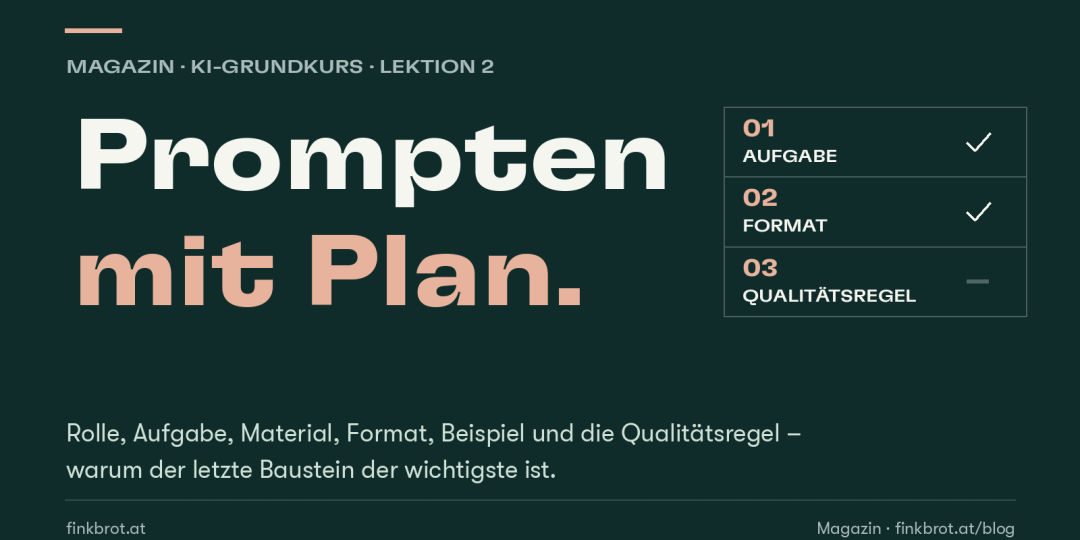
A good instruction for a language model consists of six building blocks: role and context, exactly one task, clearly separated material, format and length, tone, and quality rules. The most important one is the quality rule “invent nothing – if information is missing, ask”. It replaces much of the confident guessing with honest questions. Once you understand the building blocks, you build every instruction yourself instead of collecting templates. You practise this in the free prompt workshop on your own case.
This lesson is station 2 of the AI basics course. It explains the theory behind the prompt workshop, where you then build this yourself. Once you have understood the six building blocks, you no longer need a template collection.
Why is a normal question not enough?
Because the model knows nothing about you. It knows neither your business nor your tone, and it guesses at everything that is missing. A good instruction replaces guessing with information. You are not talking to a person, you are configuring a machine. Precision is not impolite.
What are the six building blocks?
First the role with its context: who is helping here, for what kind of business. Second the task, exactly one per instruction. Third the material, clearly separated, for example with three quotation marks. Fourth format and length. Fifth the tone. Sixth the quality rules.
The order is deliberate: first the setting, then the task, then the material, finally the guard rails. Every omission gets filled with the model's own average, and that sounds like nobody.
This lesson in two sentences:
A good AI instruction consists of six building blocks: role and context, exactly one task, clearly separated material, format and length, tone, and quality rules. The most important building block is the quality rule: invent nothing, and ask when information is missing.
Why is the quality rule the most important building block?
Because it changes the behaviour at knowledge gaps. Without it, the model delivers a confident invention, since some plausible next word always exists. With the line “Invent nothing – if information is missing, ask” you get honest questions far more often.
In the workshop this building block is therefore fixed and cannot be switched off. It costs one line and makes the most expensive class of errors far rarer.
Why separate the material?
The model has to be able to tell the instruction from the material. If a pasted email itself contains a request, without separation it may get carried out. Three quotation marks before and after the material lower this risk considerably. They are not complete protection.
Exercise: build it instead of memorising it
Open the prompt workshop and pick the case closest to your daily work. Read the reasoning for each building block, replace the placeholders with a real case and try the instruction out.
Then the counter-test: the same task as a one-liner, without building blocks. The difference in the answer is the lesson. Continue with the data traffic light, station 4 of the course.