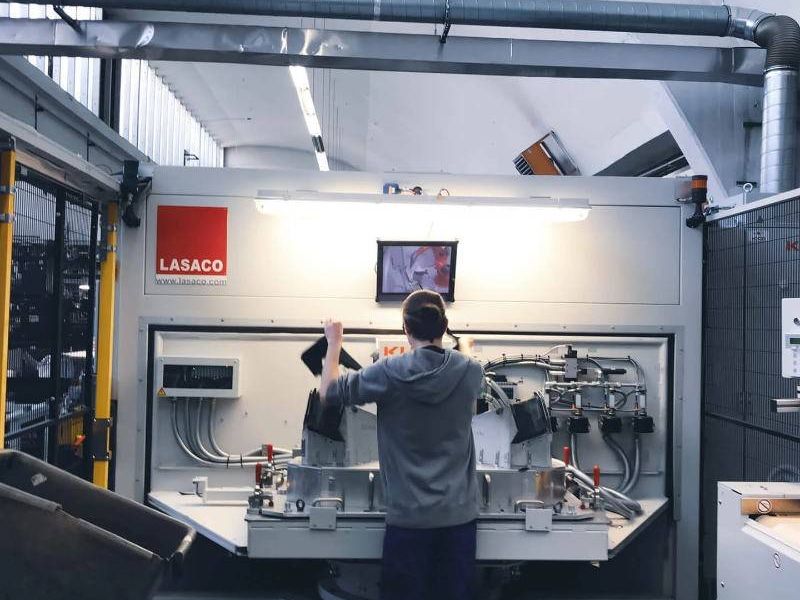
Website relaunch for LASACO.com, solutions partner in welding technology and automation


Digital accessibility, data-efficient technology, and a clear structure for a leading industrial company in Upper Austria

Industrial Web Design in Upper Austria

Industrial companies today face the challenge of presenting complex products and services online in a clear and engaging way. This was precisely the goal of the relaunch of lasaco.com in 2022. LASACO, a leading system partner for welding technology and automation based in Steyr, commissioned FINK Brot to redesign its website.

The requirements were clear: a streamlined, high-performance, and privacy-conscious web solution that gives customers quick access to information while presenting LASACO’s diverse business areas in a well-structured way. By choosing the Kirby CMS, we opted for a lean and flexible system that not only performs reliably but is also easy to maintain in the long term.

The relaunch illustrates how industrial web design can succeed: functional, user-friendly, and focused on digital sustainability.

Visit the LASACO website: https://lasaco.com

LASACO – System Partner for Welding, Laser Technology, and Automation in Upper Austria

Founded in 1998 and based in Steyr, LASACO GmbH brings more than 25 years of industry experience. The company is a reliable partner for businesses in mechanical engineering, metal processing, and automation, offering a comprehensive portfolio of:

  • Welding technology

  • Laser technology

  • Industrial robotics

  • Automation solutions

The range includes not only LASACO’s own solutions but also products from leading manufacturers such as Lorch, Tecna, and Reis Robotics – reflecting quality and long-standing industry partnerships. This combination of cross-manufacturer consulting and hands-on expertise makes LASACO a system partner that understands and implements individual requirements.

In addition to its product expertise, LASACO provides extensive service and support, including:

  • Technical consulting

  • Planning and commissioning

  • Maintenance and spare parts supply

This ensures that customers are supported not only during the purchasing process but also in the long-term optimization of their production processes.

For an internationally active industrial company, a modern web presence is essential. The website serves as both an information and service platform and reflects the expertise LASACO has built over more than two decades. The 2022 relaunch established the digital foundation for this.

Web Design for Industrial Companies – Modern, Fast, Effective


We develop websites that showcase your products, attract new customers, and deliver strong technical performance– privacy-conscious, high-performance, and SEO-optimized.

Let’s talk about your digital future: in a no-obligation initial consultation, we’ll show you how we make industrial websites successful across the DACH region.

Initial Situation & Challenges in the Website Relaunch

Before the 2022 relaunch, LASACO faced a situation typical for many industrial companies: the existing website was functional but no longer met the growing demands for usability, performance, and international visibility.

Previous Website – Key Issues

  • Unclear structure: The wide portfolio in welding technology, laser systems, robotics, and automation was difficult to navigate.
  • Technical limitations: Outdated systems caused longer loading times and made content maintenance difficult.
  • Data Protection: The use of external fonts and tracking tools created challenges for a privacy-conscious implementation.
  • Lack of multilingual support: No optimized English version was available for international markets.

Target Group Requirements

  • Industrial customers expect quick orientation and precise product information.
  • Buyers and decision-makers require clear contact options as well as technical data at a glance.
  • International markets demand a multilingual and mobile-friendly website.
  • Technicians and service staff look specifically for spare parts, service offerings, and direct contacts.

The relaunch was therefore designed not only to renew the technical foundation but also to establish a structured user experience tailored to different user groups – from initial information to detailed product search.

Results & Benefits for LASACO: A Fast, Clear, and Privacy-Conscious Industrial Website

The relaunch of lasaco.com addresses key requirements of industrial companies: quick orientation, reliable technology, and an implementation mindful of privacy standards. For LASACO, this means fewer hurdles for potential customers, more efficient workflows within the team, and a stable foundation for future growth.

  • Improved Visibility & Structure

    A clear information architecture guides users quickly to products, services, references, and contact options. This strengthens visibility for search queries related to industrial web design and relevant industry keywords.

  • Noticeable Performance Gains

    Lean code, local fonts, and optimized images improve Core Web Vitals. Pages load quickly – especially on mobile – which supports dwell time and user interaction.

  • Privacy-Conscious by Design

    A data-minimized setup (local assets, reduced third-party scripts) builds trust with security-minded B2B customers – without intrusive banners or unnecessary tracking.

  • Accessible User Experience

    WCAG-oriented markup (contrast, semantic structure, keyboard operability) improves accessibility for all user groups – including technical and service teams in the field.

  • Low-Maintenance Content Management

    The Kirby CMS enables modular content and clear workflows. The LASACO team can update pages, product details, and news more efficiently – without complex toolchains.

  • Ready for International Markets

    The DE/EN setup and consistent navigation support international inquiries and facilitate expansion.

Result: A B2B website that performs well in search engines, takes data protection seriously, and stands out with clear usability.

Lasaco.com Website

Questions?

Contact us

Results & Benefits for LASACO: a fast, clear, and privacy-conscious industrial website

The relaunch of lasaco.com addresses key requirements of industrial companies: quick orientation, reliable technology, and a privacy-conscious implementation. For LASACO, this means fewer hurdles for prospects, more efficient workflows within the team, and a stable foundation for future growth.

Conclusion: LASACO now has a future-ready B2B website – technically lean, SEO-optimized, privacy-conscious, and consistently user-oriented.

Everything You Need to Know About Industrial Websites (FAQ)

A website relaunch often raises many questions – especially in the B2B and industrial sector, where topics such as costs, SEO, data protection, performance, and multilingual support are critical. In this FAQ, we answer the most common questions our clients ask when planning the relaunch of an industrial website – concise and practice-oriented.

  • What are the concrete benefits of relaunching an industrial website?

    Short answer:
    A relaunch leads to more qualified inquiries, a better user experience, and faster loading times – all essential for B2B industrial companies.

    Detailed answer:
    A professional relaunch of an industrial website improves not only the design but above all the structure and findability of content. Especially for companies with a complex portfolio – such as in welding technology, laser technology, or automation – it is crucial that decision-makers and buyers can quickly find the relevant information.

    Through a clear information architecture, clean navigation, and internal linking, content becomes easier to understand, and search engines can better index it. On the technical side, lean code, locally hosted fonts, and optimized Core Web Vitals ensure faster loading times – a ranking factor that directly improves visibility.

    The result:

    • More inquiries from qualified customers

    • Better user experience for different target groups (procurement, engineering, service)

    • Higher visibility in search engines through SEO-optimized structures

    This makes the relaunch a growth driver for industrial companies, as it sustainably supports digital sales.

  • How much does web design for industrial companies cost?

    Short answer:
    The cost of industrial web design varies depending on scope. Key factors include the number of pages, required features, multilingual setup, and SEO requirements.

    Detailed answer:
    An industrial web design project is highly individual and cannot be answered with a flat price. Instead, costs depend on several aspects:

    • Scope & structure – number of pages, templates, and content elements

    • Functions & modules – e.g., product catalog, download section, filter options

    • Multilingual support – German only, or also English/other languages

    • Design & branding – custom screen design vs. modular adaptations

    • SEO & content – search engine optimization, content revision, keyword strategy

    • Hosting & privacy – privacy-conscious hosting in the EU, lean implementation with minimal third-party services

    For smaller industrial websites, projects typically start in the mid four-figure range (EUR). More complex B2B portals with product catalogs, multilingual support, and an SEO setup usually fall into the five-figure range.

    What matters most is the long-term perspective: a professional, privacy-conscious, and SEO-optimized website is an investment in visibility and sales performance. Rather than focusing on one-time costs, it pays to consider the ongoing benefits – such as more qualified leads, better user experience, and international reach.

  • Kirby CMS or WordPress – why do we use Kirby?

    Short answer:
    Kirby is leaner, more secure, and lower-maintenance than WordPress – making it ideal for industrial websites with high demands on performance and privacy.

    Detailed answer:
    Many companies know WordPress as the most widespread CMS. However, for industrial websites that prioritize performance, security, and ease of maintenance, Kirby CMS offers clear advantages:

    • File-based instead of database-heavy – Kirby does not require a database. This reduces potential attack surfaces, simplifies backups, and makes the system highly stable.

    • Lightweight performance – less code and fewer dependencies lead to faster loading times and improved Core Web Vitals.

    • Flexibility without plugin overload – Kirby relies on modular content blocks instead of numerous third-party plugins, which can often pose security risks.

    • Straightforward content management – content can be maintained in a clear and structured way, without cluttered admin interfaces.

    • Privacy-conscious by default – local integrations (e.g., fonts) are standard, while external scripts are kept to a minimum.

    For industrial companies like LASACO, this means a low-maintenance, secure, and future-proof solution that combines technical quality with ease of use.

  • Does a privacy-friendly website need a cookie banner?

    Short answer:
    By using local fonts, minimizing third-party scripts, and choosing privacy-friendly analytics tools, a large cookie banner can often be avoided.

    Detailed answer:
    Privacy is especially important for industrial websites, where many clients operate in sensitive sectors such as manufacturing and automation. To reduce unnecessary data collection, many modern projects follow a “privacy by design” approach:

    • Local fonts and assets – no unnecessary requests to external servers

    • Minimized third-party scripts – only features that are truly required

    • Privacy-friendly analytics such as Matomo – cookie-free tracking that avoids personal data

    • Transparent integration – a clear cookie strategy if technically required cookies are in place

    The result: Many privacy-friendly websites do not require a traditional cookie banner, since no personal data is collected without consent. Where cookies are technically necessary (e.g., forms or login areas), a lightweight consent solution is often more user-friendly than intrusive overlays.

    This approach creates websites that are trustworthy, user-focused, and efficient, while also improving overall performance.

  • How can website performance and Core Web Vitals be improved?

    Short answer:
    Fast loading times and stable Core Web Vitals can be achieved through lean code, optimized images, clean markup, and targeted caching.

    Detailed answer:
    Website performance today is not only critical for users but also a key ranking factor in search engines. Especially in the B2B sector, potential customers quickly leave if content loads too slowly. A performance-first strategy therefore addresses several core measures:

    • Lean code – avoiding unnecessary frameworks and redundant scripts

    • Image optimization – using modern formats (WebP, AVIF), lazy loading, and automatic scaling

    • Critical CSS & resource management – loading key content immediately, less relevant elements on demand

    • Server-side caching – ensuring short response times even under heavy load

    • Clean, semantic markup – improving both accessibility and search engine indexing

    These measures lead to significantly better values in Core Web Vitals (Largest Contentful Paint, First Input Delay, Cumulative Layout Shift). The result: mobile-friendly, fast websites that convince users and can sustainably achieve better rankings.

  • Is accessibility mandatory – and how do you implement it in practice?

    Short answer:
    An accessible website is not only inclusive but also improves usability and SEO. The foundation is the WCAG guidelines, which define key standards.

    Detailed answer:
    Whether accessibility is legally required depends on the sector and company size. Public institutions in the EU have been obliged for years to make their digital services accessible. For many private companies, the topic will become increasingly relevant in the coming years – for example in Austria, where the Accessibility Act (BaFG) will gradually take effect from 2025. (For details, see our blog post on the Accessibility Act in Austria.)

    In practice, accessible websites are based on the Web Content Accessibility Guidelines (WCAG 2.1, Level AA). Key measures include:

    • Clear contrasts for good readability

    • Full keyboard operability

    • Semantic HTML and logical heading hierarchy

    • Alt text for images and icons

    • Simple, easy-to-understand forms

    These measures not only improve digital accessibility for people with disabilities but also strengthen mobile usability and search engine visibility.

    The result: Websites that are accessible to all users – whether in the office, on the shop floor, or on the go.

  • How does content migration work, for example from WordPress to Kirby?

    Short answer:
    Migration takes place in three steps: audit, mapping, and import – ensuring that content and rankings are preserved.

    Detailed answer:
    Switching CMS platforms is a sensitive process for many industrial companies: content, search engine rankings, and existing structures must not be lost. That’s why we follow a systematic approach when migrating from WordPress to Kirby (or other systems):

    • Content audit – analyzing the existing website: content, URLs, backlinks, and traffic data. This shows which elements must be carried over.

    • Mapping & structure – aligning content with the new Kirby modules while optimizing information architecture and simplifying navigation.

    • Migration & redirects – transferring content cleanly into Kirby CMS. Old URLs receive 301 redirects so that rankings and external links remain intact.

    In addition, we review metadata, images, and downloads and adapt them to the new structure. The result is a smooth transition in which not only content is preserved but also SEO and usability are improved.

    For LASACO, this meant a seamless migration without losses – and at the same time a stronger SEO foundation for future visibility.

  • How do you build a multilingual website for industrial companies?

    Short answer:
    With a CMS like Kirby, multilingual websites for industrial companies can be implemented efficiently – including a clean URL structure, SEO optimization, and straightforward content management.

    Detailed answer:
    Industrial companies often operate internationally and need to reach customers in multiple languages. For a multilingual website to be successful, it requires a combination of technical foundation, SEO measures, and simple editorial workflows.

    Key factors in implementation:

    • Clean language structure – e.g., /at for German and /en for English, expandable to further languages

    • SEO optimization – each language version has its own metadata, titles, descriptions, and hreflang tags

    • Consistent navigation – users can switch between languages at any time

    • Efficient editorial processes – content can be managed side by side in the CMS, synchronized or customized

    • Scalability – additional languages can easily be added when new markets are targeted

    The result: a user-friendly and search engine–optimized multilingual website that builds international visibility while strengthening local markets. This was also a decisive factor for LASACO to address both German- and English-speaking audiences equally.

  • Which SEO measures are especially important for industrial and B2B websites?

    Short answer:
    The key factors are a clear structure, a technically sound foundation, and content tailored precisely to the search intent of the target audience.

    Detailed answer:
    SEO in the industrial and B2B sector differs from consumer-oriented projects: decision-makers search for solutions, technical data, or suppliers – often using very specific terms. For a B2B website like lasaco.com to be successful, the following measures are essential:

    • Information architecture & structure – clear navigation, logical directories, short click paths

    • Technical SEO foundation – human-readable URLs, structured data (Schema.org), optimized Core Web Vitals

    • B2B keyword strategy – focus on technical terms (e.g., welding technology, laser welding, industrial robotics) combined with broader queries (e.g., industrial web design, automation Austria)

    • High-quality content – expert articles, application examples, whitepapers, FAQs – content that demonstrates expertise and addresses search intent

    • Internal linking – logical cross-references between services, products, and case studies

    • International SEO – multilingual setup with hreflang tags to address target audiences in different markets precisely

    A B2B SEO approach is less about broad reach and more about qualified leads. What matters is that the website appears for the exact search queries used by buyers, engineers, and business partners.

    The result: a strategic sales channel – visible, trustworthy, and measurably effective.

Everything You Need to Know About Industrial Websites (FAQ)

A website relaunch often raises many questions – especially in the B2B and industrial sector, where topics such as costs, SEO, data protection, performance, and multilingual support are critical. In this FAQ, we answer the most common questions our clients ask when planning the relaunch of an industrial website – concise and practice-oriented.

© FINK Brot